Avocado processing is becoming increasingly important as demand grows for avocado pulp, guacamole, avocado oil, frozen avocado, and other value-added products. For food manufacturers, choosing the right avocado processing machine is essential for improving production efficiency, reducing labor costs, and maintaining consistent product quality.
However, the best machine depends on the type of avocado product you want to produce, your processing capacity, and your production requirements. This guide explains the key factors to consider before purchasing avocado processing equipment.
1. Identify Your Avocado Processing Needs
Before selecting equipment, determine what you want to produce.
Different avocado products require different processing methods:
- Fresh avocado – washing, sorting, grading, and packing
- Avocado pulp – washing, cutting, peeling, destoning, and pulping
- Guacamole – pulp processing followed by mixing and seasoning
- Frozen avocado – washing, peeling, cutting, and IQF freezing
- Avocado oil – crushing, pulping, separation, and oil extraction
- Avocado powder – pulping, drying, and powder processing
For example, a company selling fresh avocados may mainly need an avocado washing and grading machine, while an avocado pulp manufacturer will need a more complete processing line.
2. Consider Your Required Processing Capacity
Production capacity is another important factor.
Small processors may only need a compact avocado processing machine with a capacity of several hundred kilograms per hour. Large food manufacturers may require a complete automated processing line capable of handling several tons of avocados per hour.
When choosing equipment, consider:
- Raw avocado supply
- Daily production volume
- Peak-season capacity
- Future production expansion
- Available factory space
It is usually better to select equipment with some additional capacity rather than choosing a machine that only meets your current production volume.
3. Look at the Complete Processing Flow
A good avocado processing solution should match the entire production process rather than focusing on a single machine.
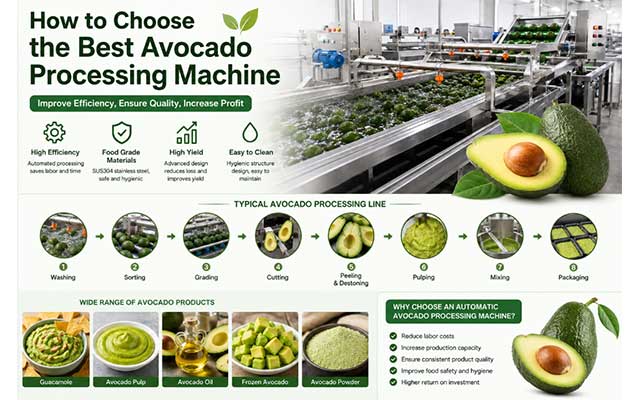
A typical avocado processing line may include:
Avocado Receiving → Washing → Sorting → Grading → Cutting → Peeling → Destoning → Pulping → Mixing → Packaging
The actual process can be adjusted according to the final product.
For fresh avocado processing, washing, sorting, grading, and packing may be sufficient. For avocado pulp production, additional peeling, destoning, and pulping equipment will be required.
4. Choose Automatic Equipment for Higher Efficiency
Manual avocado processing requires significant labor and can result in inconsistent processing quality.
An automatic avocado processing line can integrate multiple machines and reduce manual operations. Features such as conveyors, automatic sorting, PLC control, adjustable processing speed, and automatic feeding can improve production efficiency.
Automation is especially useful for medium- and large-scale factories where stable production and labor savings are important.
5. Pay Attention to Fruit Quality and Product Yield
Avocados are relatively soft fruits, so excessive mechanical pressure can damage the fruit and reduce the quality of the final product.
When evaluating an avocado processing machine, consider:
- Gentle fruit handling
- Peeling efficiency
- Pulp recovery rate
- Seed separation efficiency
- Product consistency
- Reduction of fruit waste
For pulp and guacamole production, a high pulp recovery rate can have a direct impact on production profitability.
6. Choose Food-Grade and Easy-to-Clean Equipment
Food hygiene should be a priority when selecting avocado processing equipment.
Machines used in direct contact with avocados should generally use food-grade stainless steel, such as SUS304 stainless steel, and should have smooth surfaces with minimal areas where food residues can accumulate.
Easy-to-clean equipment can help:
- Reduce cleaning time
- Improve production hygiene
- Reduce cross-contamination risks
- Simplify daily maintenance
For commercial food processing plants, machine design should also allow convenient access to key components for cleaning and maintenance.
7. Consider Customization Options
There is no single avocado processing machine suitable for every factory.
Equipment may need to be customized according to:
- Avocado variety
- Fruit size
- Raw material condition
- Processing capacity
- Final product
- Factory layout
- Automation requirements
For example, a manufacturer producing avocado pulp may need a different configuration from a company producing frozen avocado slices.
Therefore, it is useful to provide the equipment supplier with your raw material information, target capacity, and final product requirements before purchasing.
8. Don’t Focus Only on the Machine Price
The cheapest machine is not necessarily the most economical option.
When comparing different avocado processing equipment, consider the total cost of ownership, including:
- Initial equipment investment
- Labor requirements
- Energy consumption
- Water consumption
- Maintenance costs
- Spare parts
- Production efficiency
- Product yield
A machine with a higher initial price may provide better long-term value if it offers higher efficiency, lower labor requirements, and better product recovery.
9. Choose a Supplier That Can Provide a Complete Solution
For a complete avocado processing project, working with an experienced equipment supplier can simplify the process.
A professional supplier should be able to provide:
- Processing flow design
- Machine selection
- Production line layout
- Equipment manufacturing
- Installation and commissioning
- Operator training
- Technical support
This is particularly important when setting up a complete avocado processing plant, because the performance of each machine needs to work together as part of the entire production line.
10. Final Checklist Before Purchasing
Before buying an avocado processing machine, ask the supplier:
- What is the actual processing capacity?
- What avocado varieties can the machine handle?
- What is the expected product yield?
- What is the complete processing flow?
- Which parts can be customized?
- What materials are used for food-contact parts?
- How easy is the machine to clean and maintain?
- What is the power and water consumption?
- Are installation and commissioning services available?
- Can the supplier provide a complete production line?
Conclusion
Choosing the best avocado processing machine starts with understanding your product, capacity, processing flow, and automation requirements. Whether you are processing fresh avocados, producing avocado pulp, making guacamole, or developing frozen avocado products, the right equipment can significantly improve production efficiency and product quality.
For manufacturers planning a complete avocado processing project, it is better to evaluate the entire processing line rather than selecting individual machines based only on price. A properly designed avocado processing solution can provide higher productivity, consistent quality, and better long-term operating efficiency.